Aurora, Texas UFO Incident
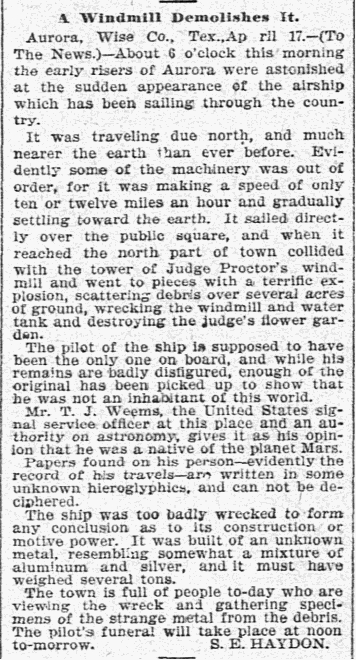
On 19 April 1897, witnesses across Texas observed an airship that collided with a windmill on the Proctor farm in Aurora, Texas, and exploded. The explosion was visible as a flash of light and fire up to three miles away. An allegedly non-human pilot was reportedly found in the wreckage.
A 1973 forensic investigation confirmed that an explosion had occurred at the site. Debris-field analysis showed the capsule first exploded on its lower right side, scattering fragments eastward and northeastward over 2-3 acres on a rocky limestone hill. Metal detector surveys recovered fragments buried up to 17 inches deep.
One particularly significant fragment was found 100 feet west of the well site, embedded four inches deep at the limestone bedrock — appearing to have melted and flowed downward under gravity. X-ray fluorescence analysis revealed the fragment consisted of 95 atomic percent aluminum and 5 atomic percent iron, with zero copper content. This composition is anomalous: commercial aluminum alloys containing iron invariably also contain copper.
Photomicrographs revealed needle-shaped iron-aluminum intermetallic crystalline inclusions, with higher density at the edges than the center. The center showed 98% Al and 1-2% Fe with large stress-free grains and shrinkage cavities confirming prior melting. The purity of the aluminum was not consistent with 1897 production capabilities and was described as difficult to produce even in 1973 when the analysis was performed.
Background
On April 17, 1897, the Dallas Morning News published a dispatch reporting that an unknown aerial craft had struck a windmill on the property of Judge J.S. Proctor in Aurora, Texas. The incident occurred during a period of widespread aerial sightings across the United States.
The Incident
According to the newspaper account by correspondent S.E. Haydon, the crash resulted in significant debris scattered across the area. A deceased occupant was recovered, with remains described as clearly not of terrestrial origin.
Local residents allegedly buried the pilot in the Aurora cemetery. Fragments of the craft reportedly bore inscriptions in an unrecognizable script.
Historical Context
This account appeared during the Great Airship Wave of 1896-1897, a period marked by widespread reports across the United States:
- Hundreds of people reported sightings
- Objects described as cigar-shaped or dirigible-like
- Sightings occurred primarily in night sky observations
Investigation and Skepticism
Subsequent investigations have cast substantial doubt on the Aurora story. Key findings include:
- No physical evidence has ever been authenticated
- Multiple attempts to locate the alleged grave proved inconclusive
- No recovered artifacts have been verified
Many researchers regard the newspaper account as either a deliberate hoax or a colorful tall tale crafted to attract attention to a declining small town.
Significance
The Aurora incident occupies a unique position in UAP history as one of the earliest alleged crash-retrieval stories. Although widely considered a fabrication, it illustrates how reports of non-human craft and occupants existed decades before the Roswell narrative. The case also demonstrates the role of local journalism in shaping and propagating UAP mythology during the 19th-century airship wave.