Roswell Crash in New Mexico
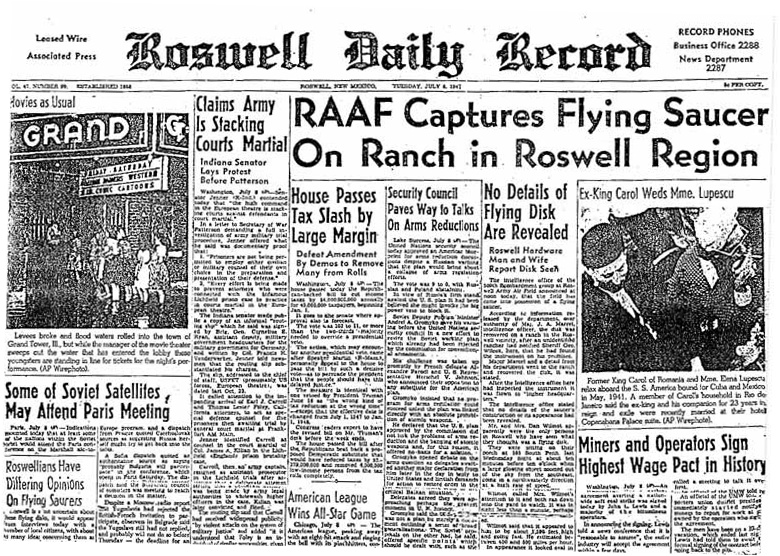
After unusual debris was found on a ranch near Roswell in July 1947, the US military initially announced recovery of a „flying disc" — only to retract the statement the next day, calling it a weather balloon. The incident involves two debris sites: Mac Brazel's Foster Ranch and a second field near the Plains of San Augustine. Whether secret Project Mogul or something else entirely, Roswell remains the most debated event in UFO history.
Videos
Background
In the summer of 1947, rancher Mac Brazel discovered unusual debris on his property northwest of Roswell, New Mexico, leading to an initial military announcement of a "flying disc" that was quickly retracted as a weather balloon. The incident faded from memory until the late 1970s, resurfacing with witness accounts and sparking ongoing debates about extraterrestrial involvement and government cover-ups.
The Incident
In the summer of 1947, rancher Mac Brazel discovered unusual debris — lightweight metallic material with unknown properties — on his property northwest of Roswell.
Brazel reported the find to the local sheriff, who contacted Roswell Army Air Field.
On July 8, the base press office announced recovery of a "flying disc" — corrected the next day to a weather balloon.
Witness Accounts
The matter faded from public memory for decades until the late 1970s, when firsthand witnesses began sharing their accounts.
Major Jesse Marcel, who had originally recovered the debris, stated the materials were "not of this world".
Simultaneously, reports circulated about a second crash site near the Plains of San Augustine, where a more intact object with occupants was allegedly recovered.
Investigation
The US Air Force released two reports in 1994 and 1997.
- The debris came from a Project Mogul balloon monitoring Soviet nuclear tests.
- The alleged bodies were crash test dummies.
Significance
Many researchers and eyewitnesses consider these explanations inadequate.
Roswell remains the epicenter of the UFO debate — a symbol of both the possibility of extraterrestrial contact and government concealment.
Elizondo's Account
In Imminent, Elizondo presents Hal Puthoff's electromagnetic pulse (EMP) hypothesis for the Roswell crash. According to this theory, high-altitude nuclear detonation tests in the late 1940s may have generated EMP effects that disrupted the craft's navigation or propulsion systems. Elizondo also discusses the analysis of recovered bismuth-magnesium layered material allegedly associated with the crash, noting that laboratory replication attempts of this metamaterial's isotopic composition proved challenging. The material analysis was connected to broader research by Nolan and Vallée on anomalous UAP-associated materials.
Significance
Roswell is the foundational event of modern UAP culture. The military's initial announcement of a recovered 'flying disc,' followed by an immediate retraction claiming a weather balloon, established a pattern of institutional contradiction that persists in UAP discourse today. No single incident has generated more investigative journalism, government inquiries, and public speculation about extraterrestrial contact.