Belgian Wave: NATO F-16 Intercept — Radar Lock Triggers 1,100 mph Evasion
During the night of 30-31 March 1990, the Belgian Gendarmerie reported three anomalous lights in an equilateral triangle formation to the radar controller at Glons tracking station. The NATO facility at Semmerzake scrambled two F-16 fighters to intercept.
Pilots achieved multiple brief radar lock-ons during the pursuit, but each acquisition triggered an immediate and extreme evasive response. During the initial lock-on, the object accelerated from 170 to 1,100 mph within seconds, while simultaneously varying altitude from 9,000 feet down to 5,000 feet, back up to 11,000 feet, and finally near ground level — maneuvers far exceeding the performance envelope of any known aircraft.
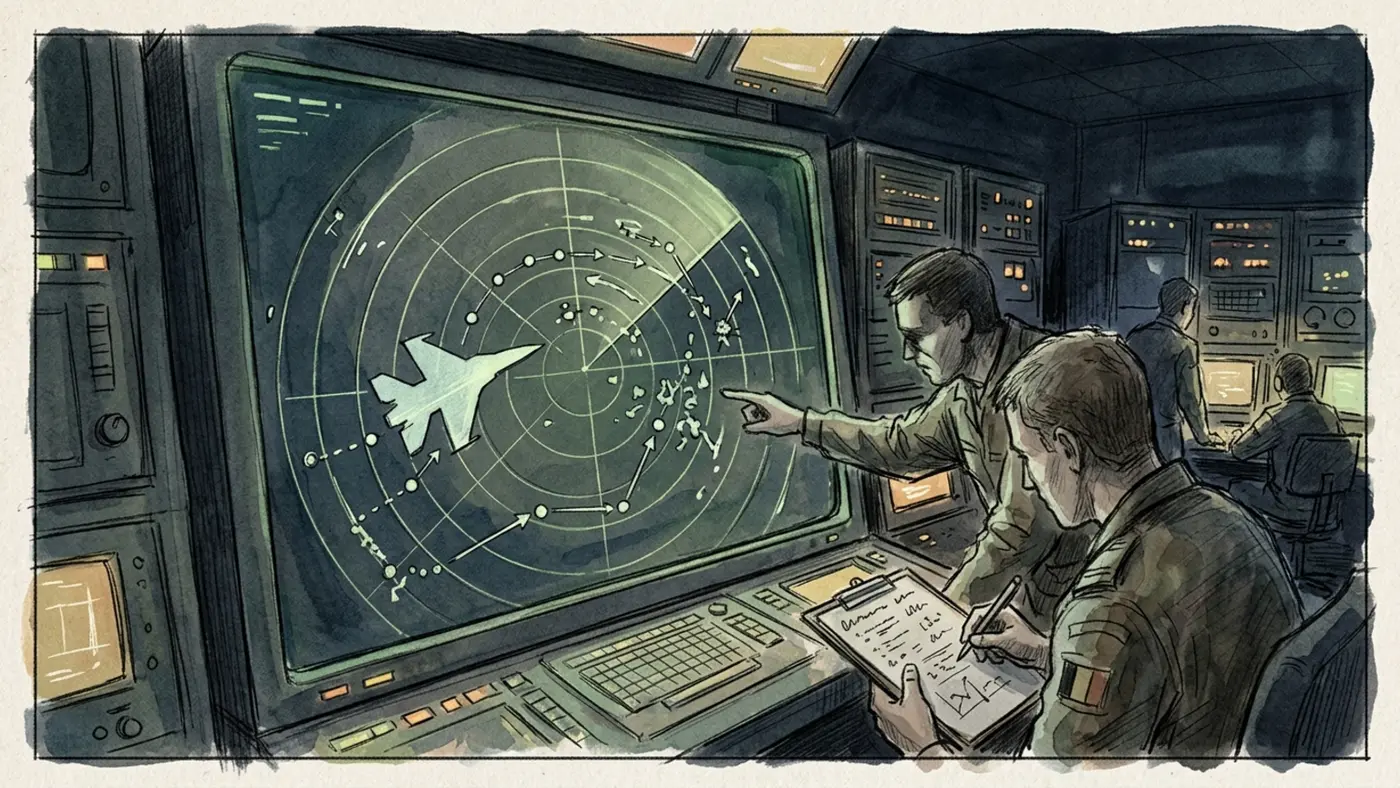
The Belgian Air Force Electronic War Center subsequently analyzed the F-16 computerized radar recordings and released a montage including two radar images of the tracked UAP. The combination of NATO-scrambled interceptors, instrument-grade radar data, coordinated ground observer reports, and official institutional acknowledgment makes this one of the most rigorously documented military UAP encounters in history.
The incident was overseen by General Wilfred De Brouwer, whose Special Task Force had been coordinating the Belgian response since the wave began in November 1989.
[Dolan Vol.2 enrichment]: Dolan Vol.2 extensive detail on March 30-31 night: At 10:50 PM NATO radar at Glons receives call from Wavre police about triangular lights. Police patrol confirms. Radar detects target at 40 kph. 2.5 hours of observations of up to 3 sets of triangular lights near Brussels outskirts. At 11:56 PM NATO Air Defense Commander authorizes F-16 scramble. F-16s achieve radar lock-ons but each time lock is obtained, radar lock breaks and object takes evasive action, dimming lights when jets arrive. During first radar lock-on, UFO speed changes from 150 to 970 knots, drops altitude from 9,000 to 5,000 feet, then returns to 11,000, then drops to ground level — nearly one mile altitude drop in one second. Jamming signal breaks second lock. Object exploits radar weaknesses (slow/stationary target filtering). After 75 minutes, intercept called off. 2,000+ witnesses in Belgium and northern Germany. SOBEPS analysis with Leon Brenig (nonlinear dynamics) and Prof. August Meessen (Catholic University Louvain) concludes 'none of these hypotheses make any sense.' Jean-Pierre Petit (CNRS Director, cosmologist): acceleration of 40g at Mach 1.5 near ground impossible for any man-made machine due to heating — conclusion: 'not of terrestrial origin.'
Videos
Background
On the night of March 30-31, 1990, the Belgian Air Force scrambled two F-16 Fighting Falcons to intercept unidentified objects detected by NATO radar and reported by hundreds of ground witnesses. The F-16 pilots achieved radar lock multiple times, but the objects displayed extraordinary capabilities beyond known aircraft.
The Incident
During the pursuit, the objects accelerated from approximately 280 km/h to over 1,800 km/h (about 1,100 mph) in seconds.
They dropped from 3,000 meters to near ground level almost instantaneously.
The objects performed sharp turns at speeds generating forces fatal to any human pilot.
Official Response
The Belgian Air Force officially acknowledged the events and released the radar data.
They noted the objects' flight characteristics were beyond any known aircraft capabilities.
Major General Wilfried De Brouwer led the military investigation and later confirmed the authenticity of the encounters.
Key Facts
- Date: Night of March 30-31, 1990
- Aircraft: Two F-16 Fighting Falcons
- Detection: NATO radar installations and hundreds of ground witnesses
- Capabilities demonstrated:
- Acceleration: 280 km/h to >1,800 km/h in seconds
- Altitude drop: 3,000 m to near ground level instantly
- Sharp turns with lethal G-forces for humans
Significance
Only ONE F-16 camera had satisfactory radar recording — second camera failed. This meant electromagnetic interference could not be ruled out. Press conference July 11, 1990 by Col. De Brouwer. QRA procedure: dual confirmation required (police visual + radar detection).