Rendlesham Forest Incident
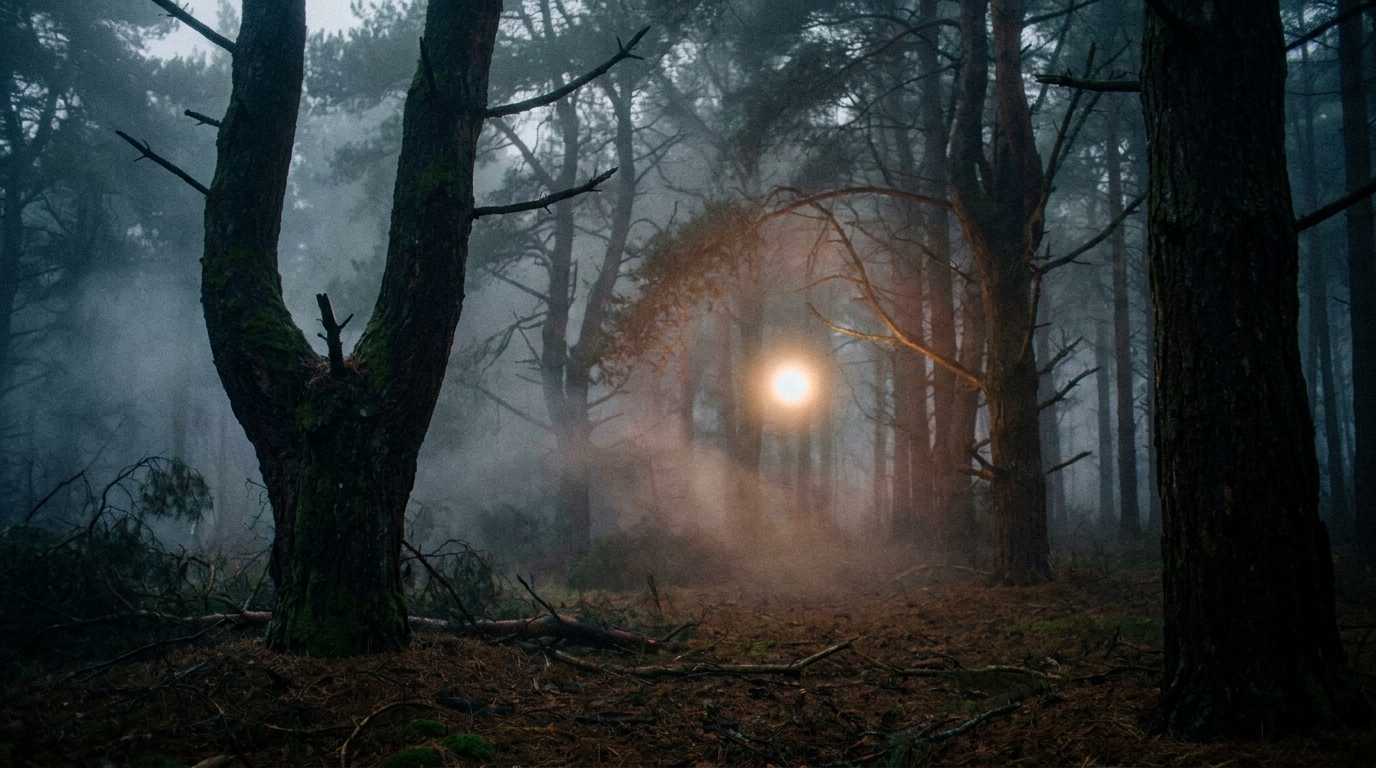
Over two nights in late December 1980, U.S. Air Force personnel stationed at RAF Woodbridge in Suffolk, England, reported encounters with unexplained lights and a metallic craft in the adjacent Rendlesham Forest. The case is supported by an official memo from Lt. Col. Charles Halt and remains one of Britain's most investigated UFO incidents.
Videos
Background
In the early hours of December 26, 1980, a security patrol from RAF Woodbridge spotted unusual lights descending into Rendlesham Forest. Despite investigations, no definitive explanation has been offered for the encounter reported by trained military observers.
The Incident
A security patrol from RAF Woodbridge — a NATO air base in Suffolk leased to the USAF — spotted unusual lights descending into the nearby forest.
Sergeant Jim Penniston and his team investigated and reportedly encountered a triangular metallic craft emitting bright light.
Penniston later claimed to have touched the object and noted hieroglyphic-like symbols on its surface.
Witness Accounts
SSgt. Jim Penniston, the senior security officer at RAF Woodbridge, described approaching a silhouetted triangular craft about 9 feet long by 6.5 feet high sitting in a forest clearing.
- The craft was surrounded by blue and yellow lights and the air felt electrically charged, causing static electricity on skin and hair.
- Penniston conducted a full physical examination, finding the surface smooth like glass but warm, with a constant low voltage running through it.
- On one side, he observed pictorial symbols measuring about three inches high and two and a half feet across, with a triangle as the largest central symbol.
- After approximately 45 minutes, the craft silently lifted off and departed at what Penniston logged as Speed Impossible.
- He also took two rolls of 35mm film of the craft, but the photos were reportedly overexposed or fogged during development.
- Three triangular indentations were found at the landing site, along with broken branches and scorch marks on nearby trees.
Investigation
Two nights later, Deputy Base Commander Lt. Col. Charles Halt led a larger team into the forest.
Halt documented anomalous light readings with a Geiger counter and recorded his observations on audio tape.
His subsequent memo to the UK Ministry of Defence confirmed multiple witness accounts.
Findings
Lt. Col. Charles Halt, who investigated the second night with a small team, documented elevated radiation readings (seven times normal background), broken branches, and tree abrasions at the landing site.
- Using a pocket tape recorder, Halt captured eighteen minutes of observations as his team encountered a bright red-orange oval object that maneuvered through the trees under apparent intelligent control.
- The object eventually exploded into five white lights that moved rapidly.
- Other objects appeared in the northern and southern sky, and one sent down a concentrated pencil-like beam compared to a laser that illuminated the ground near the team.
- Critically, beams were also directed at or near the weapons storage area.
- The team experienced persistent radio communication difficulties throughout the encounter.
The day after, Colonel Gordon Williams played the tape at a Third Air Force staff meeting, and agents from the Air Force Office of Special Investigations (AFOSI) secretly investigated the case, reportedly using harsh interrogation techniques on witnesses.
Analysis
Despite investigations by both British and American authorities — including the RAF and the U.S. Air Force — no definitive explanation has been offered.
Skeptics have proposed a nearby lighthouse and meteor sightings as possible causes, but these fail to account for the physical trace evidence and consistent testimony from trained military observers.
Elizondo's Account
Elizondo discusses the Rendlesham Forest incident in Imminent as one of the most well-documented military UAP encounters. He notes that AATIP considered it a key case demonstrating multiple observables, including reported electromagnetic interference with equipment and alleged biological effects on witnesses. The case remained significant within the intelligence community's UAP analysis framework alongside Malmstrom AFB and other nuclear-adjacent incidents.
Significance
Often called Britain's Roswell, the Rendlesham Forest incident is exceptional because it involved multiple trained military observers across consecutive nights near a facility storing nuclear weapons. Deputy base commander Charles Halt documented anomalous radiation readings in an official memo, and witnesses faced career consequences for coming forward. The case demonstrated both the quality of evidence military witnesses can provide and the professional risks of UAP reporting. Kean Ch. 18 provides first-person accounts from both key witnesses: PENNISTON (Night 1, Dec 26): Senior security officer with top-secret US+NATO clearance. Three-man patrol with Airman First Class John F. Burroughs and Edward Cabansag. Physical examination of craft for ~45 minutes: triangular shape, 9 feet long, 6.5 feet high. Smooth surface 'like glass' with metallic quality, warm to touch, electrically charged air. Blue and yellow swirling lights. Symbols on hull — pictorial/hieroglyphic, largest was triangle within circle. No landing gear, windows, or visible propulsion. Silent liftoff — 'Speed Impossible' written in logbook. Physical evidence: broken branches, scorch marks, three indentations in triangular pattern. 2 rolls of 35mm photos confiscated (told 'overexposed'). HALT (Night 2, Dec 27/28): Tape-recorded 18 minutes of real-time audio. Object sent narrow beam of light directly into nuclear weapons storage area. Bentwaters radar tracked object at 3,000-4,000 mph. Nigel Kerr at RAF Watton confirmed radar target. Radiation 7x above normal at landing site. Colonel Gordon Williams (Wing Commander 81st TFW) was Penniston's superior. General Robert Bazley declared it 'a British affair.' OSI/AFOSI subjected 5 young airmen to sodium pentothal and hypnosis. Lord Hill-Norton (former UK Chief of Defence Staff) advocated Parliamentary investigation. Halt memo to MoD dated January 13, 1981.